
Too many facility managers hire a commercial roofer in Glasgow the same way: search online, pick three names, invite quotes, and award to the lowest. It can lead to repeat call-outs, the same leak reappearing, and eventually paying twice to have the work done properly. Commercial roofing isn’t a commodity service. Water ingress disrupts operations, liability accumulates fast, and a botched repair costs more to undo than it would have cost to do right. This guide gives you a practical framework for vetting commercial roofing contractors in Glasgow before a single quote is invited. Not all contractors come close to the standard you need.

What does a qualified commercial roofer in Glasgow actually look like?
Commercial roofing is a different discipline from domestic work, and the gap shows in certifications, insurance levels, and site capability. Many contractors list “commercial roofing” on their website without the credentials to back it up. Knowing exactly what to ask for is the first filter.
Accreditations that carry real weight
CHAS (Contractors Health and Safety Assessment Scheme) confirms that a contractor has demonstrated compliant health and safety management systems, including risk assessments, working-at-height controls, and insurance. Constructionline confirms procurement and capability data, including financial stability, compliance policies, and business conduct. Both matter, and both can be verified directly with the issuing body. Don’t rely on a PDF the contractor emails over; cross-check the company’s legal name against the certificate issuer’s register. If the name doesn’t match the quoting entity, ask why before going further.
NFRC (National Federation of Roofing Contractors) membership is a stronger signal than most people realise. NFRC vets applicants on technical competence, health and safety, insurance, and code of practice compliance before admitting them, then continues to monitor member conduct. It’s not a directory listing; it’s a vetted register. Ask whether the contractor’s membership is current and covers commercial flat roofing or industrial roofing specifically, not just pitched domestic work.
Insurance minimums for commercial work
Ask for three documents: public liability insurance, employers’ liability insurance, and, where the contractor is specifying the roofing system themselves, professional indemnity insurance. Check policy dates, the named insured, the cover amounts, and the scope of work explicitly covered. Public liability for commercial roofing work should be substantial; many clients require multiple millions of pounds in cover for larger projects, in line with industry procurement guidance, and the policy must be live on the day you award the contract. A contractor who can’t produce this documentation promptly has told you something useful.
BBA certification and manufacturer-approved installer status
BBA certification applies to the roofing product or system, not to the contractor installing it. A BBA certificate tells you the membrane or system has been independently assessed for performance and durability. What it doesn’t tell you is whether the contractor in front of you is qualified to install it correctly. Manufacturer-approved installer status is a separate check that covers that gap. Verify both: confirm the proposed system has a current BBA certificate and confirm the contractor appears in the manufacturer’s approved installer directory. Many manufacturer warranties are void if the installer isn’t approved. Skip this check, and your warranty is worthless from day one.
Roofing systems used in Glasgow and the real cost picture
Glasgow’s wet, wind-heavy climate narrows which roofing systems perform well over time. Understanding the options lets you assess whether a contractor’s recommendation is genuinely suited to your building or just what they happen to install.
Common systems and their lifespans
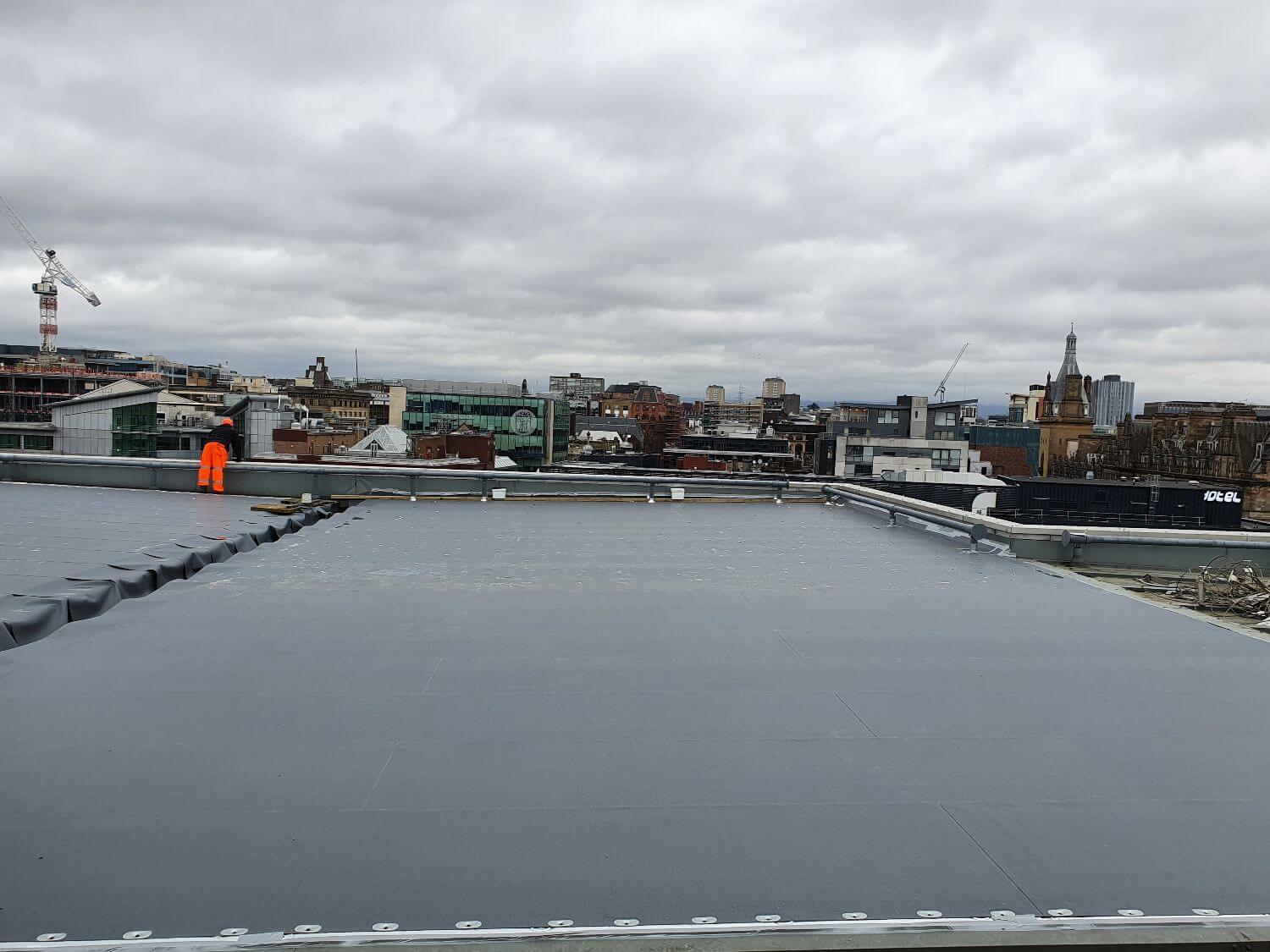
EPDM (rubber single-ply) offers 20 to 50 years of service life and suits Glasgow’s rainfall well. It’s low maintenance but vulnerable to undetected seam failure and punctures if inspections aren’t kept up.
PVC single-ply typically lasts 15 to 30 or more years, with heat-welded seams that outperform adhesive bonds in wet conditions. It’s more resistant to chemicals and biological growth, which matters on roofs near kitchen extraction or industrial processes.
Torch-on felt and modified bitumen ranges from 10 to 30 years, depending on ply count and installation quality. These systems need more frequent inspection and patching cycles than single-ply membranes, and older felt roofs often hide significant substrate deterioration.
Metal cladding sits at the top for longevity, with well-maintained systems lasting 40 to 70 years. Fastener condition, sealant integrity, and corrosion checks still determine whether it reaches that upper range.
What do repair and replacement actually cost in 2026?
For commercial roofing in Glasgow in 2026, flat membrane repair typically runs £100 to £180 per m². Full flat-roof replacement costs around £50 to £130 per m² depending on system and specification, with single-ply replacement pricing at roughly £60 to £100 per m² and metal cladding replacement from £80 to £150 per m². These are practical 2026 estimates based on current UK market pricing. They assume straightforward access and reasonable substrate conditions. Costs push toward and above the upper end when access is difficult, when the substrate requires structural repair, or when building regulations trigger insulation upgrades as part of the replacement. A quote that comes in significantly below these ranges without a clear explanation is worth scrutinising, not celebrating.
Maintenance obligations by system type
EPDM and PVC are both low maintenance, but “low maintenance” is not the same as “no maintenance.” The most common failure mode on both systems is the ignored seam and flashing detail. Scheduled inspections, frequency depending on roof condition and risk profile, but typically at least once or twice a year, catch these issues before they become water ingress. Commercial roof maintenance in Glasgow is a year-round obligation given the climate, not something to address reactively. Torch-on felt requires more active patching cycles and regular inspection at upstands and penetrations. Metal needs periodic fastener and sealant checks, particularly after high winds. Any contractor who doesn’t discuss a maintenance plan after installation is leaving you to discover the next problem on your own.
Emergency response and inspection capability: where most Glasgow roofers fall short
Standard roofers can quote on a repair. Fewer can respond within hours after storm damage, and fewer still have the diagnostic technology to find the actual source of a leak rather than just patching the visible symptom. This is where genuine capability becomes visible.
What 24-hour emergency response actually mean in practice?
There’s a meaningful difference between a contractor who “offers emergency callouts” and one with a structured rapid-response capability. Quality Glasgow commercial roofing contractors can assess the same day after storm damage or acute water ingress. Same-day permanent repair usually isn’t possible, and you should be sceptical of anyone who claims otherwise without seeing the roof. The realistic sequence is same-day assessment, temporary weatherproofing installed promptly, and a planned permanent repair once scope and materials are confirmed. Ask directly: What is your average response time after an emergency call, and what does your emergency process actually look like?
How do drone survey diagnostics change the inspection process?
Thermal imaging drone surveys detect moisture ingress, membrane delamination, and heat loss without scaffolding, without destructive opening-up, and without the time cost of manual inspection on large roofs. On a sizable flat roof, the visible leak point is rarely the actual entry point. Water travels under the membrane and surfaces elsewhere. A contractor who patches the drip marks without investigating the broader moisture picture is treating the symptom, not the problem. The Balmore Group combines drone survey capability with commercial roofing expertise, diagnosing before repairing. That sequence matters. Ask any Glasgow commercial roofer directly: how do you locate the source of a leak before you start work?
Rope access and high-level work capability
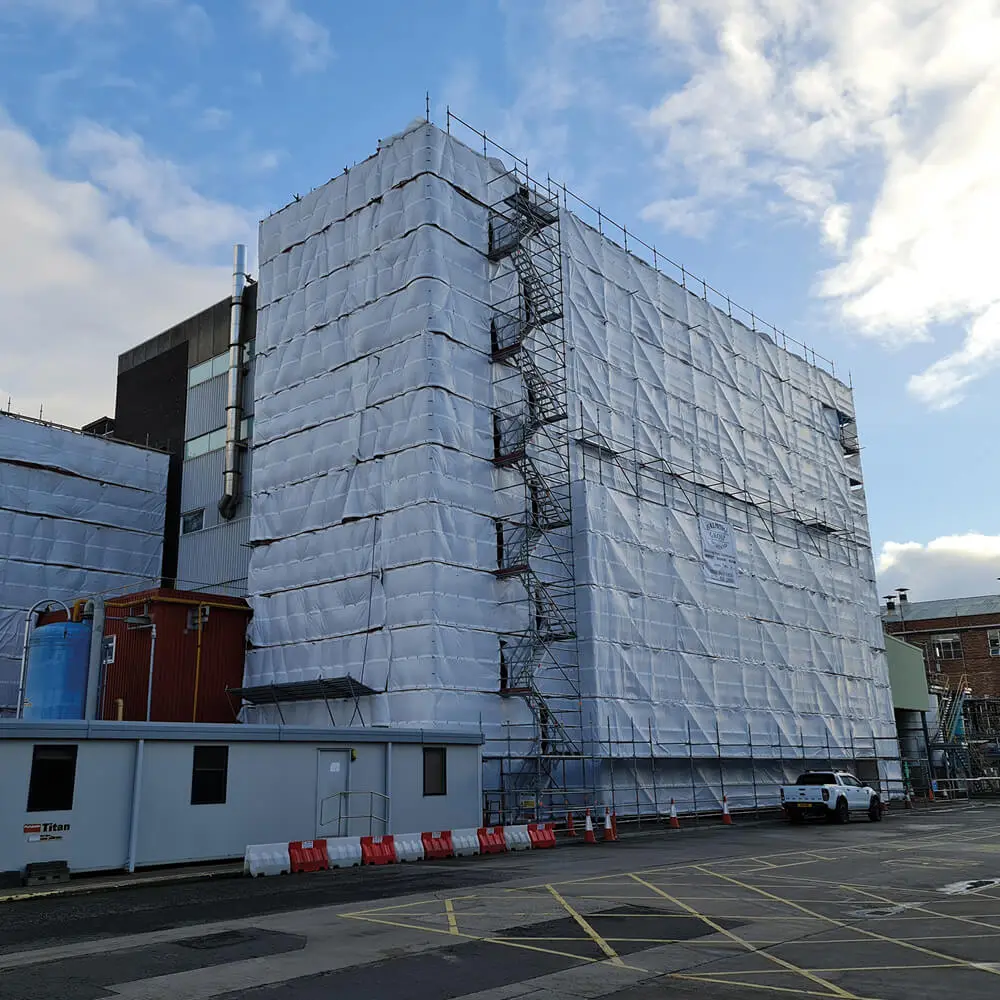
On older Glasgow city-centre buildings and many industrial sites, conventional scaffolding is impractical, slow, or both. Rope access-qualified roofing teams reduce lead time, site disruption, and access cost significantly. For multi-storey commercial buildings or industrial roofing work in constrained environments, rope access capability is a genuine differentiator. Ask whether the contractor’s teams hold current rope access qualifications covering the access method required for your specific building.
Glasgow-specific planning and compliance requirements
The regulatory layer that sits on top of roofing work is the thing facility managers most consistently underestimate. Getting it wrong delays a project or creates a compliance problem after completion that’s harder and more expensive to resolve than dealing with it upfront.
When do you need building control or planning permission?
Routine like-for-like repairs generally don’t require planning permission. Roof replacement, material changes, or alterations that affect the building’s external appearance often do, especially in conservation areas. Building control involvement is usually required for full commercial roof replacement to confirm thermal performance, structural safety, and fire compliance under Scottish building regulations. A building warrant application for work submitted from 6 April 2026 onward is assessed against current Scottish building standards, which means insulation performance requirements apply in full. A contractor who doesn’t mention this is either unaware of it or hoping you aren’t.
Listed buildings and conservation area constraints
Glasgow has a significant listed stock across the city centre and beyond. Listed building consent is typically required for any roof alteration on a listed building, including material changes, flashing details, and anything that affects its special architectural or historic character. Like-for-like repair using genuinely like-for-like materials may be exempt, but that determination should come from Glasgow City Council’s planning conservation team, not from the contractor’s assurance. Conservation area buildings face heightened planning scrutiny even without individual listing: material matching, roofline preservation, and heritage statements may all be required. Start this conversation with the council early, ideally before contractors are briefed, because listed building consent decisions take around eight weeks and can run longer.
Energy efficiency obligations triggered during replacement
Full roof replacement or major refurbishment commonly triggers insulation upgrade requirements under current building regulations. This affects both the technical specification and the project cost, and it’s not optional. A contractor who doesn’t raise insulation compliance in their quote may be underspecifying to win on price. The resulting building warrant application will flag the gap, at which point the scope and cost increase anyway, later and under more pressure.
The questions to ask before you award the contract
Every section in this article prepares you to ask better questions. These are the ones that separate a genuinely capable Glasgow commercial roofing contractor from one that looks credible on a website.
Certification and warranty questions that matter
Ask for current CHAS and Constructionline certificates and verify them directly with the issuing bodies, for proof of manufacturer-approved installer status for the proposed system, insurance certificates showing the named insured, cover amounts, and policy dates. Ask for the warranty terms: both the workmanship warranty issued by the contractor and the system warranty issued by the manufacturer. A contractor who becomes evasive or uncomfortable with any of these requests has already answered your most important question. Practical guidance on verifying CHAS accreditation is available via ATAC, and the NFRC provides member guidance and FAQs that help confirm a company’s standing on its FAQ page.
Red flags that signal a contractor to avoid
Walk away from any commercial roofer in Glasgow who shows these warning signs:
- No verifiable accreditation from CHAS, Constructionline, or NFRC
- Inability to produce insurance documents promptly
- No discussion of building regulations, planning implications, or insulation requirements
- No explanation of how safe roof access will be managed
- Pressure to make a quick decision
- Quotes significantly below the others with no clear explanation of what’s been omitted
The lowest quote rarely reflects the lowest total cost once rework, compliance failures, and warranty gaps are included.
Realistic lead times and disruption to plan for
Standard repairs: often within days. Commercial replacement or major refurbishment: expect one to four weeks of onsite work, with four to eight or more weeks of total lead time once materials, planning, and access arrangements are confirmed. Emergency assessment from a quality contractor: same day. Set these expectations internally before briefing contractors so that responses can be evaluated honestly rather than optimistically. A contractor who promises full replacement within a week on a large roof is either overcommitting or omitting something.
Vetting a commercial roofer in Glasgow is straightforward if you ask the right questions
Whether you’re comparing quotes for a planned flat roof repair in Glasgow, responding to storm damage, or setting up a scheduled commercial roof maintenance programme, the framework in this article gives you a reliable basis for making the right call. Don’t award a commercial roof contract on price alone. Award it on capability.
The five filters that matter are accreditations, insurance, system knowledge, emergency capability, and planning awareness. Contractors who check all five can be harder to find than you’d expect. Price-led procurement tends to surface the wrong names first. The Balmore Group is a Glasgow-based commercial roofing contractor with drone diagnostics, rope access capability, and emergency response, backed by over 40 years of practical experience across commercial and industrial roofing in Glasgow. Contact us today









Quotes & Enquiries
At Balmore, we offer the expertise of four decades in difficult access works including roofing, rope access, industrial cleaning and drone inspection services. Our one stop shop approach to inspection, repair and cleaning has grown through our desire to constantly exceed our clients expectations and offer a service that is far superior to our competitors.
Please fill in the form outlining your requirements and our contract team will be able to provide you with a bespoke quotation for your inspection, repair or cleaning needs.


